Narcolepsy Nerd Alert: The Science of Narcolepsy
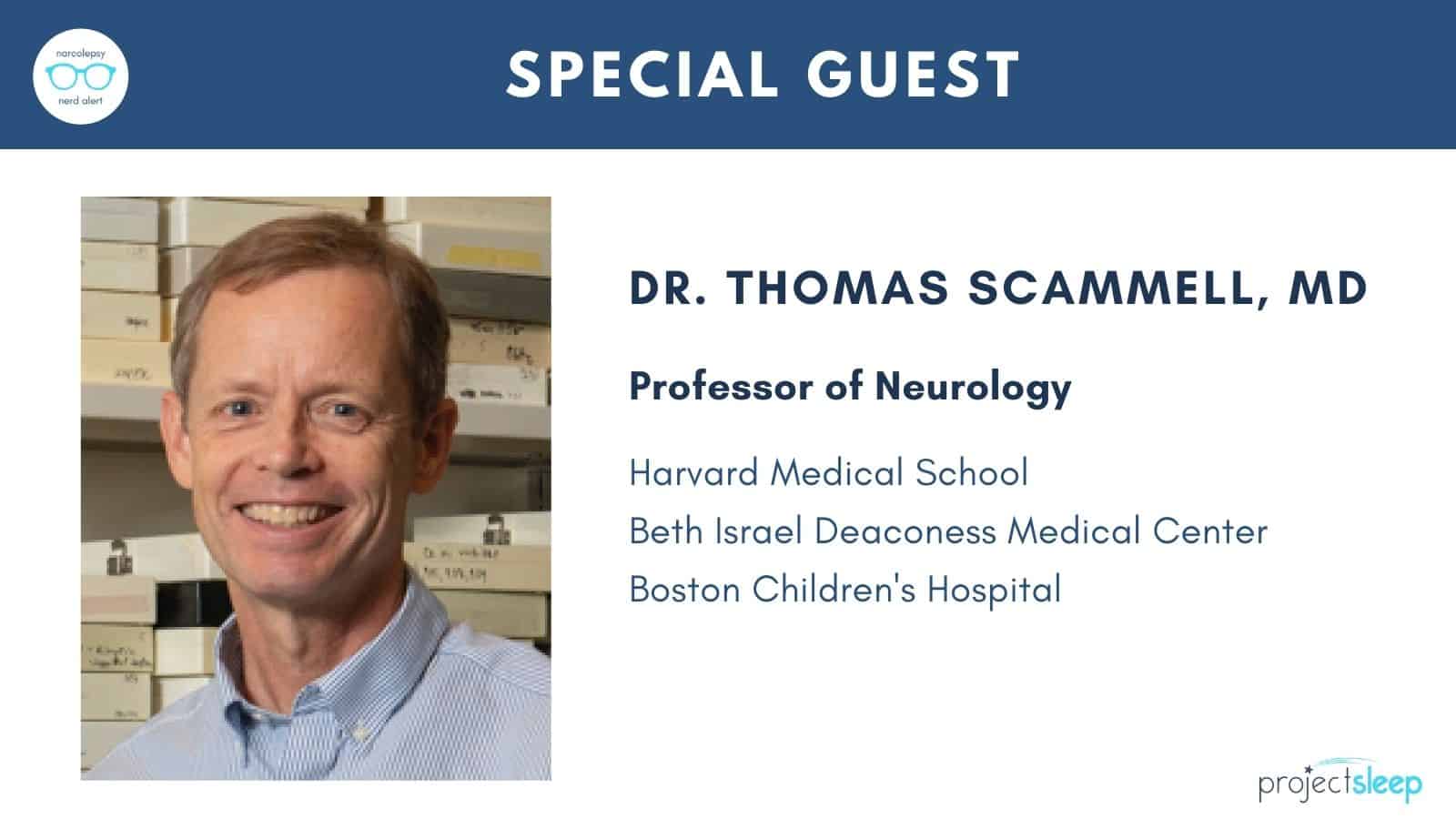
Narcolepsy is a neurological condition — so what’s actually happening in the brain and nervous system? Scientific advancements in the last two decades have greatly improved our understanding of sleep and wakefulness and led to new treatments for narcolepsy and other sleep disorders. Project Sleep President and CEO, Julie Flygare, hosted the “Science of Narcolepsy” broadcast with special guest Dr. Thomas Scammell, MD, Professor of Neurology at Harvard Medical School, to dive into the neurobiology of narcolepsy.

Use the buttons below to jump to the different formats of this conversation and be sure to download the Science of Narcolepsy toolkit for more information.

Recording

Toolkit

Podcast

Transcription

Download the Science of Narcolepsy Toolkit

Narcolepsy Nerd Alert toolkits accompany each broadcast. These guides are designed for people living with narcolepsy and their loved ones to offer new tools, tips, and perspectives on navigating narcolepsy.

Development of Narcolepsy

The likelihood of developing narcolepsy depends on three main factors:

  • Some people are genetically predisposed to develop type 1 narcolepsy.
  • People in a certain age range – late adolescence to early adulthood – are more likely to develop narcolepsy. 
  • Usually an immune trigger precedes narcolepsy symptoms.

While narcolepsy was identified in 1870, for a long time the underlying cause was unknown. In the late 1990s, researchers found that people who have type 1 narcolepsy, or narcolepsy with cataplexy, lack specific neurotransmitters called orexins, which are also known as hypocretins. 

Orexins are necessary for the regulation of the sleep-wake cycle and are produced by a group of neurons located in the hypothalamus, a part of the brain that helps regulate sleep and circadian rhythms.

  • Low levels of orexins observed in type 1 narcolepsy are due to 90- 95% loss of the orexin producing neurons in the brain.
  • There is limited research on these neurons in type 2 narcolepsy.
  • The loss of orexin-producing neurons is due to a process called molecular mimicry. Essentially, the body’s natural immune response mistakenly kills the orexin producing neurons.

Neurobiology of Sleepiness

How does loss of orexin neurons lead to sleepiness? For people without narcolepsy, the orexin neurons send strong signals to turn on other parts of the brain that promote wakefulness by releasing neurotransmitters such as acetylcholine, histamine, dopamine, serotonin, and norepinephrine.

Without orexins, as in type 1 narcolepsy, these other regions of the brain are not consistently getting the signal to release the neurotransmitters that would keep you awake. The result is that people with narcolepsy feel sleepy and easily lapse into sleep.


The sleepiness of narcolepsy is fundamentally about poor maintenance of wakefulness. The normal, consistent alertness that most people have just doesn’t work well in narcolepsy.”

– Dr. Scammell

Neurobiology of Cataplexy

How does a strong emotional trigger lead to muscle weakness? First, you perceive something funny, surprising, etc. Without orexins, the amygdala is unopposed and turns off the brain regions that should be “putting the brakes” on REM sleep, especially the paralysis of REM sleep. Ultimately, this inhibits the motor neurons that control muscles, and cataplexy occurs.

Genetic Factors

Everyone has a section of their DNA called the HLA-DBQ1 gene, which is involved in the body’s immune response. Many versions of this gene exist. Researchers identified one specific version of the gene, called *06:02, which is found in the DNA of most people with narcolepsy.

  • Over 90% of people with type 1 narcolepsy carry the *06:02 gene.
  • Over 50% of people with type 2 narcolepsy carry the gene.
  • 10-25% of the general population, i.e. people without narcolepsy, carry the gene too.

Enviornmental Factors

If a person is genetically predisposed to develop narcolepsy, an immune trigger often precedes the onset of narcolepsy symptoms. The immune response leading to the loss of orexin neurons can even be triggered by something as common as a strep infection.

Not everyone with narcolepsy can identify a specific infection that may have brought on their symptoms, especially as a diagnosis often does not come until years after symptom onset.

For more information on this topic, download the Science of Narcolepsy toolkit!

I don’t encourage people to stress too much about developing narcolepsy or what caused them to develop narcolepsy. You have to live your life and not worry about the triggering things.”

– Dr. Scammell

The Science of Narcolepsy: Listen or Watch!

This broadcast originally aired on August 25, 2021.

Meet Our Guest:

Dr. Thomas Scammell, MD received his Doctor of Medicine degree from the University of Massachusetts Medical School, where he trained in internal medicine.  He also completed a residency in Neurology at the University of California, San Francisco, and a fellowship in Sleep Medicine at Beth Israel Deaconess Medical Center.

Dr. Scammell is a Professor in Neurology at Harvard Medical School, Beth Israel Deaconess Medical Center, and Boston Children’s Hospital. He serves as an ad hoc reviewer for New England Journal of Medicine, Annals of Neurology, Nature, Cell, and Neuron, and was a Deputy Editor of SLEEP.  He was a member of the International Classification of Sleep Disorders Task Force, the Sleep Research Society Board of Directors and the APSS Program Committee.

The author of over 150 journal articles and chapters, Dr. Scammell has lectured both nationally and internationally on narcolepsy and the neurobiology of sleep and wakefulness. His current research interests include identifying how loss of orexin signaling results in sleepiness and cataplexy, development of new medications for narcolepsy, interactions of sleep and pain, and sleep disorders in Prader-Willi Syndrome.

Science of Narcolepsy Resources

Here are some of our favorite resources for navigating narcolepsy.

Mahlios, J., De la Herrán-Arita, A. K., & Mignot, E. (2013). The autoimmune basis of narcolepsy. Current Opinion in Neurobiology, 23(5), 767–773.

Mahoney, C. E., Cogswell, A., Koralnik, I. J., & Scammell, T. E. (2019). The neurobiological basis of narcolepsy. Nature Reviews Neuroscience, 20(2), 83–93.

Mignot, E., Lammers, G. J., Ripley, B., Okun, M., Nevsimalova, S., Overeem, S., Vankova, J., Black, J., Harsh, J., Bassetti, C., Schrader, H., & Nishino, S. (2002). The role of cerebrospinal fluid hypocretin measurement in the diagnosis of narcolepsy and other hypersomnias. Archives of Neurology, 59(10), 1553–1562.

Peyron, C., Faraco, J., Rogers, W., Ripley, B., Overeem, S., Charnay, Y., Nevsimalova, S., Aldrich, M., Reynolds, D., Albin, R., Li, R., Hungs, M., Pedrazzoli, M., Padigaru, M., Kucherlapati, M., Fan, J., Maki, R., Lammers, G. J., Bouras, C., … Mignot, E. (2000). A mutation in a case of early onset narcolepsy and a generalized absence of hypocretin peptides in human narcoleptic brains. Nature Medicine, 6(9), 991–997.

Thannickal, T. C., Moore, R. Y., Nienhuis, R., Ramanathan, L., Gulyani, S., Aldrich, M., Cornford, M., & Siegel, J. M. (2000). Reduced number of hypocretin neurons in human narcolepsy. Neuron, 27(3), 469–474. https://doi.org/10.1016/S0896-6273(00)00058-1

Project Sleep’s Sleep Helpline

Project Sleep’s Sleep Helpline™ is a nonprofit-led free national helpline providing personalized support and resources for people facing sleep issues and sleep disorders.

Get Personalized Information & Support

Project Sleep’s live broadcast series Narcolepsy Nerd Alert takes a deeper dive into specific topics related to narcolepsy. Hosted by award-winning geek Julie Flygare, each live event invites fellow #NarcolepsyNerds to explore unique aspects of the narcolepsy experience, contemplate bold questions, and learn from each other.

View all broadcasts and explore upcoming topics on our Narcolepsy Nerd Alert page.

Calling All #NarcolepsyNerds!

Whether you geek out about science, art, advocacy, or pop culture—this community is for you. Please sign up for updates on live broadcasts, video recordings, printable toolkits and exclusive prizes.

More Narcolepsy Nerd Alert Topics

Share this...

2 Comments. Leave new

Leave a Reply

Your email address will not be published. Required fields are marked *

Fill out this field
Fill out this field
Please enter a valid email address.
You need to agree with the terms to proceed