Narcolepsy Nerd Alert: Types of Narcolepsy
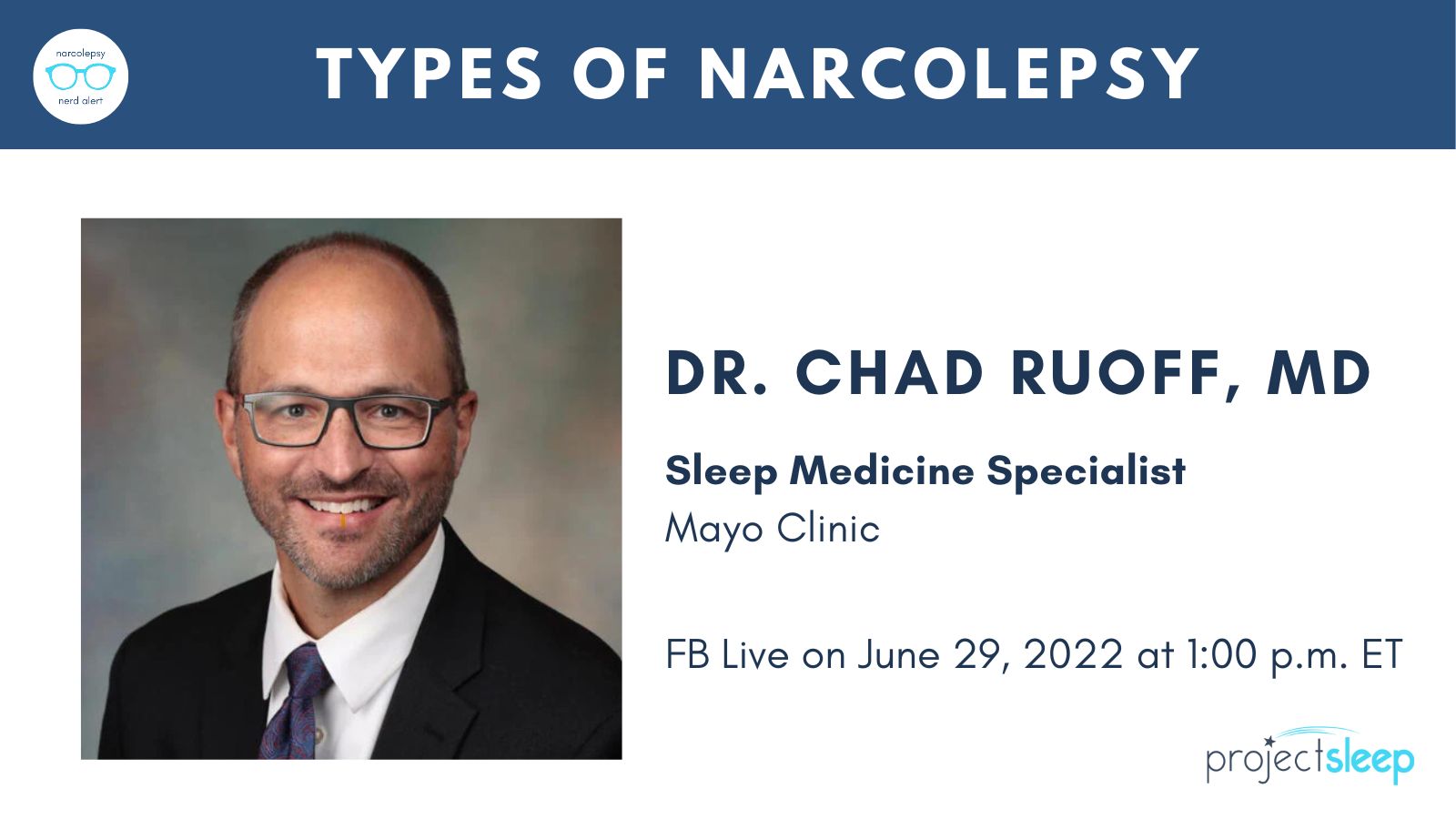
What distinguishes narcolepsy type 1, type 2, and idiopathic hypersomnia? Project Sleep President and CEO, Julie Flygare, hosted the “Types of Narcolepsy” broadcast with special guest, sleep medicine specialist Dr. Chad Ruoff, to discuss how specialists evaluate sleepiness and break down the diagnostic criteria for these conditions.

Use the buttons below to jump to the different formats of this conversation.

Recording

Toolkit

Podcast

Transcription

Download the Types of Narcolepsy Toolkit

Narcolepsy Nerd Alert toolkits accompany each broadcast. These guides are designed for people living with narcolepsy and their loved ones to offer new tools, tips, and perspectives on navigating narcolepsy.

Why Am I So Tired?

Excessive sleepiness during the daytime even after adequate sleep is called hypersomnolence. People who struggle to stay awake throughout the day may have a central disorder of hypersomnolence, also called a central nervous system (CNS) hypersomnia.

Hypersomnolence could be due to:

  • Narcolepsy type 1 (narcolepsy with cataplexy)
  • Narcolepsy type 2 (narcolepsy without cataplexy)
  • Idiopathic hypersomnia
  • An underlying condition that is not a sleep disorder, like lupus, which causes extreme fatigue

Inadequate sleep and sleep deprivation will cause anyone to feel tired during the day, but if you consistently get adequate sleep and still struggle with sleepiness, or if you are regularly unable to sleep despite your best efforts, you may have a sleep disorder, and you should talk to your doctor.

Narcolepsy Symptoms

The Narcolepsy Pentad is typically used to identify narcolepsy:

  • Excessive daytime sleepiness (EDS)
  • Cataplexy
  • Sleep-related hallucinations
  • Sleep paralysis
  • Disrupted nighttime sleep

Idiopathic Hypersomnia (IH) Symptoms

  • Excessive daytime sleepiness (EDS)
  • Prolonged sleep time
  • Unrefreshing naps
  • Sleep inertia
  • Difficult sleep-to-wake transition


It’s more than just feeling tired, it feels like someone has nailed something heavy to my face between my eyebrows, and in order to open my eyes I need to lift it with my eyelids.”

– Amy

Diagnostic Tools

Sleep specialists assess sleep-related problems using a variety of tools:

  • Symptom history
  • Questionnaires
  • Daily sleep logs
  • Actigraphy

When it comes to diagnosing narcolepsy type 1, type 2, and IH, specific tests are often used:

  • The overnight sleep study, called a nocturnal polysomnogram (PSG)
  • The multiple sleep latency test (MSLT)
  • A blood test for the HLA DQB1*06:02 gene variant
  • A cerebrospinal fluid (CSF) orexin test


In terms of advocating for yourself, it is important to know what tests are available. If you’re uncertain about your diagnosis, make sure you’ve engaged your healthcare providers to see if one or more of these tests would be helpful in your situation.”

– Dr. Chad Ruoff

Diagnostic Criteria

The table below summarizes specific criteria used to differentiate narcolepsy type 1, type 2, and idiopathic hypersomnia.

MSLT Challenges

The multiple sleep latency test (MSLT) is the primary way sleep specialists test for narcolepsy type 1, type 2, and idiopathic hypersomnia. However recent research has shown that the MSLT doesn’t consistently differentiate these conditions.

Surprisingly, people in the general population — who don’t have daytime sleepiness — may meet the diagnostic criteria for narcolepsy, leading to false positives. Remember, the current diagnostic criteria for narcolepsy are falling asleep within 8 minutes and having at least two dream periods (SOREMPs) in the five naps during an MSLT.

False negatives are also reported. Many people who do have idiopathic hypersomnia may not have a mean sleep latency that indicates a central disorder of hypersomnolence.

What’s Next?

Sleep researchers believe that the current diagnoses may not accurately categorize people with hypersomnolence based on pathophysiology — the underlying cause of their sleepiness. Changes are expected in the next version of the International Classification of Sleep Disorders (ICSD), and this is part of the process.

Being diagnosed with a chronic illness can significantly affect a person’s life and sense of identity. If a diagnosis changes later, it can be confusing and disruptive. It can be reassuring to know that changes in your diagnosis are not caused by something uniquely difficult about you or your sleepiness.

No matter how your sleepiness is labeled, know that it is valid — your experience is real.

For more information on this topic, download the Types of Narcolepsy toolkit!

These are already very stigmatized conditions, and then to have your disease name change — it can be a big change in your sense of identity. Don’t worry. You’re still part of our community. Your symptoms are real.”

– Julie Flygare

Types of Narcolepsy: Listen or Watch!

The Types of Narcolepsy broadcast originally aired on June 29, 2022.

Meet Our Guest

Chad Ruoff, M.D., is an internal medicine physician specializing in sleep medicine. He enjoys evaluating and treating all sleep disorders such as sleep apnea, narcolepsy and idiopathic hypersomnia, restless legs syndrome, parasomnias, and circadian rhythm disorders. In addition to his clinical activities, Dr. Ruoff is active in research and education, providing mentorship to medical students. He has authored and coauthored numerous publications on various topics within sleep medicine including sleep apnea and narcolepsy.

Types of Narcolepsy Resources

Here are some of our favorite resources for navigating narcolepsy.

Project Sleep’s Sleep Helpline

Project Sleep’s Sleep Helpline™ is a nonprofit-led free national helpline providing personalized support and resources for people facing sleep issues and sleep disorders.

Get Personalized Information & Support

Project Sleep’s live broadcast series Narcolepsy Nerd Alert takes a deeper dive into specific topics related to narcolepsy. Hosted by award-winning geek Julie Flygare, each live event invites fellow #NarcolepsyNerds to explore unique aspects of the narcolepsy experience, contemplate bold questions, and learn from each other.

View all broadcasts and explore upcoming topics on our Narcolepsy Nerd Alert page.
Calling All #NarcolepsyNerds!

Whether you geek out about science, art, advocacy, or pop culture—this community is for you. Please sign up for updates on live broadcasts, video recordings, printable toolkits and exclusive prizes.

More Narcolepsy Nerd Alert Topics

Share this...

Leave a Reply

Your email address will not be published. Required fields are marked *

Fill out this field
Fill out this field
Please enter a valid email address.
You need to agree with the terms to proceed